
EU Packaging and Packaging Waste Regulation (PPWR) Explained
PPWR applied from 12 August 2026. It is binding in all 27 Member States and reaches almost every business that sells a physical product in Europe.
We have summarised what it requires, who it applies to, and where to start.
What it is
Regulation (EU) 2025/40 sets sustainability and labelling requirements for packaging across its whole life cycle, production, use and waste. It replaces the packaging directive that had governed Europe since 1994.
It has three aims:
1. To prevent unnecessary packaging and promote reuse refill and recycling
2. To harmonise national rules so they stop acting as trade barriers
3. To support the circular economy and climate neutrality by 2050
The change from a directive to a regulation is the part that matters commercially. A directive is written into national law by each country in its own way, which is how one product ended up needing different packaging and labelling in different markets. A regulation applies directly and identically across the EU.
Packaging that now complies with PPWR can be marketed freely across the Union, and Member States cannot impose conflicting national requirements.
Contact us to know more!
We help you understand the requirements.
What it requires

-
All packaging must be designed for material recycling. From 2030 it must meet a recyclability performance grade; from 2035 it must also be collected, sorted and recycled at scale; from 2038 the requirements tighten further.
-
Plastic packaging must contain a minimum share of post-consumer recycled material from 2030. Exceptions apply for pharmaceutical packaging, food packaging for infants and young children, medical devices, packaging for transporting hazardous goods, and compostable plastics.
-
Packaging must be reduced to the minimum weight and volume needed for function. The regulation is explicit that marketing or consumer acceptance do not justify extra weight or volume, so premium presentation is not a defence. Packaging designed to make a product look larger, such as double walls or false bottoms, is prohibited unless protected by a design right or trademark.
-
From 2030, grouped, transport and e-commerce packaging must not exceed 50% empty space. Sales packaging must minimise empty space too.
-
From 2030, Annex V prohibits a defined list, including single-use films used to group products at the point of sale, pre-packed fruit and vegetables under 1.5 kg, single-use food and drink packaging consumed inside hotels, bars and restaurants, individual portions of condiments, sauces, coffee creamer and sugar, small single-use hotel toiletries, and most very lightweight plastic bags.
-
Reusable packaging must be designed for multiple rotations and meet safety, hygiene and recyclability requirements, and operators must run a working collection and reconditioning system. Targets from 2030: 40% of transport packaging reusable (aspirational 70% by 2040), 10% of grouped packaging (25% by 2040), and 10% of beverages in reusable packaging (40% by 2040). Large retailers must endeavour to give 10% of sales area to refill stations.
-
From 2027, restaurants and cafés must let customers bring their own containers at no extra cost. From 2028, they must also offer reusable packaging at no extra cost.
-
Harmonised labels on material composition and sorting, delivered largely by QR code.
-
PFAS are restricted in food-contact packaging and heavy metals are capped, with a general duty to minimise substances of concern.
-
Manufacturers must carry out a conformity assessment, issue an EU Declaration of Conformity and keep technical documentation for five years, ten years for reusable packaging. If non-compliance is suspected, they must take corrective action, including withdrawal or recall, and inform the authorities.
-
Producers are responsible for the whole life cycle of their packaging. Fees must cover collection, sorting and recycling, must be modulated to reward better design, and must be financially transparent.
Who is in scope?
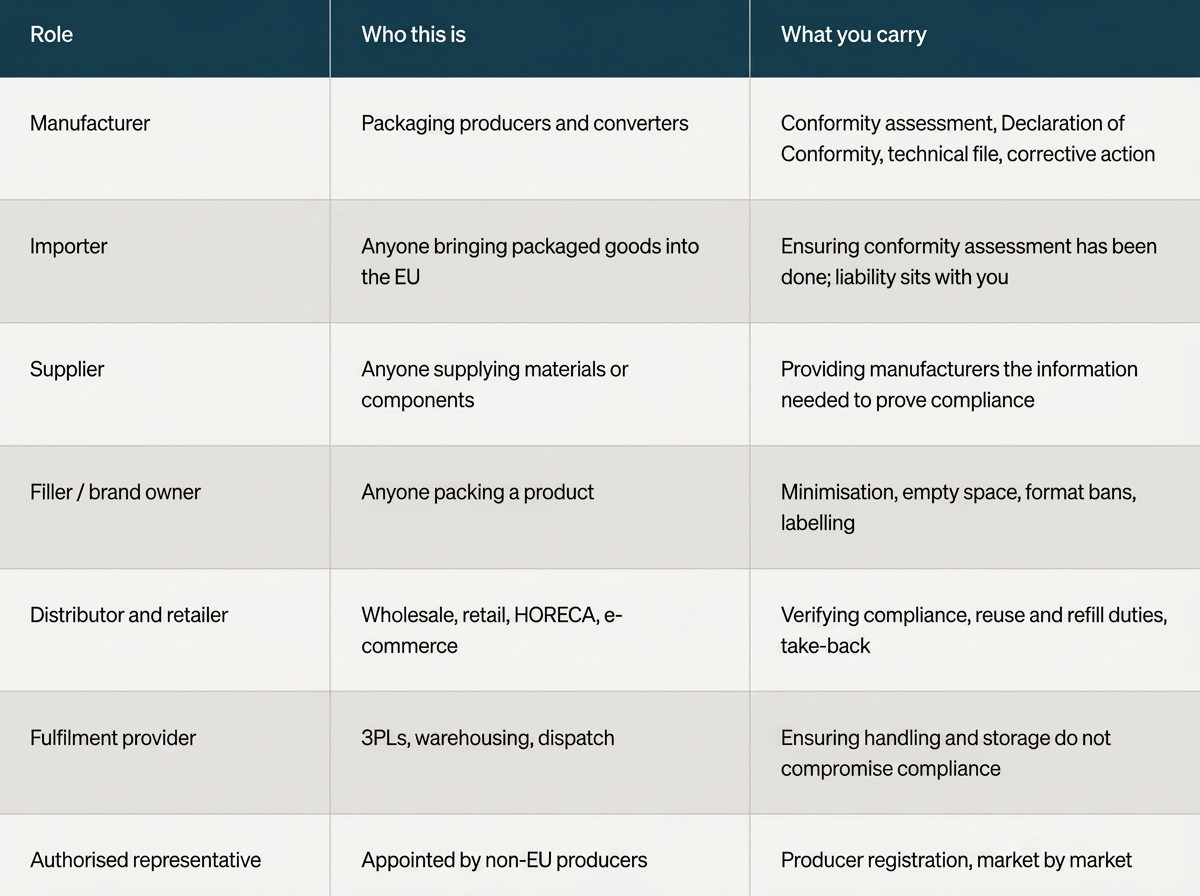
Scope follows your role, not your industry. Most groups hold more than one role and have not assigned the obligations to anyone.
All materials are covered - plastic, paper and board, glass, metal, composites, wood and textiles - across household, retail and industrial packaging alike.
Businesses selling into the EU from outside it do not escape producer obligations; those attach through a representative appointed in each market. And the exemptions listed above are narrow, they cover recycled content
and recyclability only. Labelling, chemicals, minimisation, fees and conformity documentation still apply in full.
Do you have questions about what to do when? Contact our advisors below!
When it applies
-
In force from 12 August 2026
PFAS limits in food-contact packaging, with no grace period for existing stock.
Heavy metals limits.
Design-for-recycling.
Technical documentation and the EU Declaration of Conformity.
Producer registration.
Duties for e-commerce, fulfilment and marketplaces.
-
Customers may bring their own containers for takeaway, at no extra cost
-
Harmonised labelling; reusable takeaway packaging offered at no extra cost
-
Deposit-return systems for single-use plastic and metal beverage containers
-
The main wave: recyclability grades, recycled content, minimisation, 50% empty-space cap, Annex V bans, reuse and refill targets
-
Packaging must be recycled at scale, not only designed for recycling
-
Stricter recyclability obligations
-
Higher recycled content and the longer-term reuse targets